

Created 23/3/2015.
Updated 12/16/2023.
What are complete or partial dentures?
Complete or partial dentures are removable prostheses. They are now often used as temporary dental prostheses until the entire treatment of dental implants, dental crowns or dental bridges is completed. Only in elderly people, complete or partial dentures are used as definitive prostheses. These definitive complete or partial prostheses are known as dentures.
Types of complete or partial dentures
Removable dental prostheses, whether complete or partial, are divided into two possible types of dental prostheses: partial dental prostheses (skeletal) and complete dental prostheses (dentures).
Each type of prosthesis is further subdivided into three types of prostheses: those dental prostheses that are attached only to the gum (mucosa-supported), those prostheses that are attached with teeth and gum (dento-muco-supported) and those prostheses that are attached with implants and gum (implanto-muco-supported).
Visit our clinics to explain your case. On the first visit we will perform a dental CT and a complete study, totally free of charge. In this way we will know the extent of the problem, your needs and we can advise you on the different types of dental implants, prostheses, the advantages of each one and the price of the whole treatment.
Do not doubt our professionalism, we will inform you about the best alternatives according to your situation. Book your visit today.
What are partial dentures for?
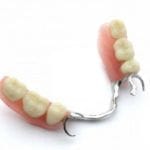 Partial dentures are used to replace several teeth, never all the teeth in the mouth. They are made of acrylic resins and in some cases have metal structures that allow them to hold better to the teeth.
What are complete dentures used for?
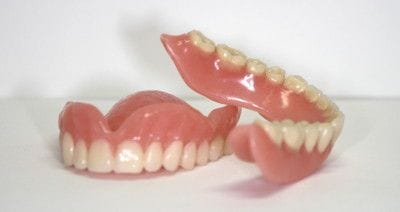 Complete dentures (full dentures) are made of a pink resin or acrylic base simulating gum color. The teeth can also be resin (acrylic) or porcelain. Complete dentures (full dentures) are almost always made of hard resin because they have a longer life because they will be supported on the gum of the mouth and the hardness of its base allows a better, firmer adhesion that will cause less wear of the bone.
However, in some cases, both full and partial dentures are made partly or entirely of flexible resin if patients have thin or weak gums that cannot withstand hard resin. Removable dentures made of flexible acrylic are very esthetic as they prevent sagging of the lips and face, but have the disadvantage that they only hold in the soft tissues and will eventually damage the gum and bone that still remain in your mouth.
Types of complete dentures
Complete dentures (full dentures) can be upper or lower. The upper complete denture is easier to hold and gives better results in use since it adheres to the palate, causing a suction effect that will allow the denture not to move. On the contrary, the lower complete denture has a less extensive base that makes it difficult to fix and also the musculature of the floor of the mouth and the face makes it more difficult to fix. This makes it more difficult for some patients to eat and speak properly.
In patients with little dental bone, in our clinic we have different methods to replace complete or partial dentures with mini dental implants. You can access this section for more information.
Adaptation process during the use of complete dental prostheses and maintenance
The use of removable complete dentures requires a period of adjustment of the same by the patient, in addition to a minimum training for their care and daily cleaning. During this period the dentist will make the necessary adaptations and corrections.
The removable dental prosthesis should be cleaned after every meal. To clean it, it must be brushed to avoid the formation of calculus (tartar) and the appearance of stains caused by some foods. The parts less accessible to the brush require immersing the denture in a cleaning solution. It is not convenient to sleep with it, since the gum where it rests needs to rest from the effort made during the day.
Patients with this type of prosthesis should have an annual check-up at the dentist since it is important to maintain an excellent fit, otherwise lesions could appear in the gum which, if they become chronic, could lead to oral cancer.
The initial review and maintenance is essential in these processes, so in all the first visits of our patients, we perform free of charge, a dental study and a CT scan. In this section you can see all the free services that you will have in your first visit. You can also access this section to see our facilities. From the first moment you will be accompanied by professionals, doctors and surgeons.
Frequently Asked Questions.
What is the process to obtain a dental implant?
The process of obtaining a dental implant involves several steps that depend on the type of prosthesis being used. Initially, the dentist may take impressions and measure the patient’s mouth to ensure an accurate implant fit. In cases where adjacent teeth remain, preparations may be necessary to ensure proper alignment and support for the implant.
For removable prostheses, several visits may be necessary to make adjustments and achieve a comfortable fit. On the other hand, fixed prostheses such as implants often involve a surgical procedure. This involves the implantation of a titanium post into the jaw bone, which will serve as the base for the replacement tooth.
After implant surgery, a recovery period is needed to allow the implant to fuse with the jaw bone through a process called osseointegration. This may take several months. During this time, the patient may be provided with a temporary prosthesis to maintain function and esthetics.
Once the implant has been successfully integrated into the jaw bone, a stump is placed in the implant. The core build-up acts as a connector between the implant and the replacement tooth or crown. This step requires additional measurements and impressions to create a custom tooth that matches the surrounding natural teeth.
Finally, the custom-made tooth is placed on the core, providing a durable, natural-looking replacement for the missing tooth. Regular follow-up visits with the dentist are essential to ensure the continued health and longevity of the dental implant.
What are dental implants and what types are there?
Dental implants are specialized artificial devices used to replace missing teeth and surrounding tissues. These implants come in different types, providing various solutions for people with tooth loss. One type is known as complete implants, which are used to replace all the teeth in a specific jaw. Another type, called partial implants, are designed to replace one or more missing teeth. Dentures can also be classified as removable or fixed, with examples of fixed options including bridges or implants. Overall, dental implants offer a reliable and durable solution for those looking to replace teeth with options tailored to their specific needs.
For any questions do not hesitate to use the chat on the page, our dentists will help you.
At IMOI Barcelona and IMOI Ibiza, we follow editorial principles that guarantee the authenticity of all the information we disseminate. If you are interested in learning more about how we ensure that our content is always up-to-date and accurately supported, we invite you to review our editorial commitment.
This article has been supervised by Dr. Ferran Novell Costa and Dra. Erjona Demiraj, specialists in Dental Health and Dental Aesthetics treatments. Responsible for the treatments provided at IMOI Barcelona and IMOI Ibiza and for the supervision and/or updating of the contents of this blog entry. (7/11/2023). The recommendations described are not generic and do not replace the diagnosis and evaluation of a professional in a dental office. If you want us to clarify any aspect or you want a personalized diagnosis and advice we recommend you to come to our dental clinics.
Reproduction in whole or in part in any medium without written permission is prohibited.


