

Dentures in sex – what do we need to know if we wear one and fear having a sex life like we used to? Is there any reason to be inhibited and believe that we should now do everything cautiously or demurely? Can dentures really radically change a couple’s sex life?
Well, this time we want you to know the precautions you should take if you wear dentures because your doctor will tell you how you should take care of them in everyday life, but usually sexual issues are not discussed in the consultation room. Here we will answer all of them.
Many factors determine that a person reaches the point of losing his or her teeth and is forced to wear dentures (either complete or partial dentures), which undoubtedly greatly improves his or her quality of life:
- Can eat normally
- Strengthens your self-esteem by being able to smile without fears
- Ensures good oral health .
Dentures are temporary or definitive prostheses that require care to avoid injuries to your gums, to prevent them from suffering deformities and to ensure that their durability is ideal; having them does not exempt the patient from not brushing after every meal, because although these new teeth will never have a cavity problem, if you do not have proper oral hygiene you may have gum infections that cause bad breath and more serious health problems.
Make an appointment at our IMOI dental clinics in Barcelona and Ibiza. On your first visit we will perform a dental CAT scan and a Premium Dental Study, totally free of charge. It is the only way to check if you have any type of infection or need any special treatment. In this link you can see all the treatments that we will perform for free in your first visit.
And it is from this point that we are going to approach the subject concerning dentures and their role in a person’ s sexual life.
Oral care before sex

Okay, here are a few things to consider now that you are wearing dentures to keep things running smoothly during sex.
- Whether or not you wear dentures, it is important to emphasize that proper hygiene is essential when it comes to sex, we can not afford to have oral infections that put at risk our health and that of our partner, especially when oral sex is involved. The only way to avoid them is to brush your teeth after every meal.
- Not having proper hygiene also causes dentures to accumulate food and halitosis (bad breath). This is due to the fact that with the food accumulated in the gums a type of bacteria grows that produce bad odor and in some cases are difficult to eliminate.
- Having prosthesis or dentures does not mean that you should stop brushing after every meal, you should do it as you normally did and paying special attention to the health of your gums. In case you notice ulcerations or suppurations, you should immediately go to your dental clinic for treatment. Avoid oral intimate relations during this period, as these types of wounds or infections could be aggravated if they come into contact with body fluids.
- You should promptly follow the cleaning recommendations that your doctor gives you, especially with regard to avoiding the proliferation of mycosis in your false teeth. At the beginning of having teeth. When you have dentures, you are more susceptible to contracting oral candida, which is a fungus present -especially- in moist areas of the body. If you develop thrush and have sex during this period, you could transmit the yeast infection to your partner, especially if your partner has a low immune system. Candida can lodge in the oral cavity as well as in the gastrointestinal and genitourinary tract, although it can also occur on the skin. The first thing to do is to be cautious!
Care for your dentures during sex
Once you know that you are in excellent health conditions and you want to recover your sexual life, we recommend the following points.
 Resume sexual activity once you have gotten used to your new teeth, be patient. It is important that for things to work properly in bed, you feel your dentures as something that is already part of you, not as something foreign and uncomfortable. Your cheek muscles should get used to your new teeth so that they are not a distraction or something that can inhibit you during sex. Besides, that way kissing will be as pleasant as it has always been.
- If you notice that your saliva production has increased or decreased, don’t worry or think that your partner might pull away from you for that reason. Use it to your advantage! Remember that if you have proper oral hygiene, saliva can function as a natural lubricant. Not everything is bad! In addition, the unusual production of saliva will gradually decrease.
- No wild sex! Forget about gags or sex toys that could remove your teeth, damage your teeth, deform them or simply render them useless. You must be very careful with this because you could even cause a jaw dislocation that moves the jaw bone out of position, which can cause, in addition to intense pain, more serious health problems in your mouth.
- Can you perform oral sex? Of course it is. Many people are afraid to kiss another person or perform oral sex for fear that their partner – if he or she doesn’t know – will notice that they have dentures. We want to tell you that science is advancing day by day and dental appliances are becoming more comfortable and less noticeable. False teeth are no exception. So, no more inhibitions and go on as you normally do.
- If the trust between you and your partner is total, you can even remove your dentures during sex, as many claim to experience new sensations and experiences. Remember to place it in a container with its cleaning agent to avoid damaging it.
 Resume sexual activity once you have gotten used to your new teeth, be patient. It is important that for things to work properly in bed, you feel your dentures as something that is already part of you, not as something foreign and uncomfortable. Your cheek muscles should get used to your new teeth so that they are not a distraction or something that can inhibit you during sex. Besides, that way kissing will be as pleasant as it has always been.
Recommendations for after sex
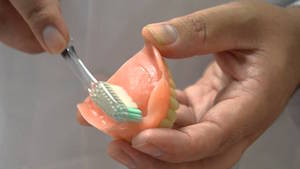 Your dentures after sex do not need to have any special/different treatment or care than what you were told at the doctor’s office: remove them, clean them thoroughly, apply an antifungal and then clean your mouth. Do not wear your dentures at bedtime because we want the saliva to clean your gums and strengthen them.
Do not bend or clench your false teeth, remember that they can easily become deformed. Once you go to sleep, clean your prosthesis and put it back on, just take it off and leave it in the solution intended for it if your dentist asks you to do so. Never expose it to hot water as it may become deformed.
We hope that these precautions and recommendations have helped you and now you can fully enjoy your sex life. Remember that dentures are not limiting.
For any information about dentures or alternatives to dentures that we perform at IMOI visit the previous sections.
What are the benefits of overdentures as a dental treatment?
Overdentures offer numerous benefits as a dental treatment. They are an excellent option for those patients who require dental implants and want to ensure that their removable prosthesis stays firmly in their mouth, providing the sensation of a fixed prosthesis. By choosing overdentures, patients can enjoy greater stability and functionality compared to a conventional removable prosthesis. In addition, overdentures improve chewing and the ability to speak properly, which in turn can improve digestion and patient confidence. These prostheses also provide greater support to facial tissues, helping to preserve bone structure and prevent collapse of the lips and cheeks. Another outstanding advantage is that overdentures are highly customizable, allowing patients to achieve an esthetic and naturally beautiful smile. In summary, overdentures are a dental treatment option that provides the benefits of stability, functionality, comfort, esthetics and bone preservation, thus improving patients’ oral quality of life.
What tools can be used to clean overdentures?
Several tools can be used to clean the overdenture. One option is a soft bristle brush to clean the metal part under the prosthesis as well as the implant anchors. In addition, interproximal brushes are useful for reaching hard-to-reach areas. It is also recommended to use a special dental floss specifically designed for dentures to remove any debris or impurities between the false teeth and the implants. Irrigators are the easiest and most effective solution for removing food debris.
How to clean the overdenture?
To properly clean the overdenture, it is important to follow some steps. After each meal, it is recommended to remove the prosthesis and clean it thoroughly. Use a soft bristle brush to clean the metal part under the prosthesis as well as the implant anchors. Interproximal brushes and special dental floss for dentures are also useful in this process. Before going to sleep, it is advisable to remove the prosthesis to allow the oral tissues to rest. When not in use, store the prosthesis in its case. Once a week, perform a special cleaning to remove bacteria, stains and prevent odor. You can use effervescent tablets available at any pharmacy. To perform this cleaning, simply place an effervescent tablet in a glass of water and immerse the overdenture for five to ten minutes. This procedure will help maintain good oral hygiene and ensure that the prosthesis is free of bacteria and unpleasant odors.
How does the overdenture work?
The overdenture is a dental prosthesis that relies on the use of dental implants for its function. At least two and up to four dental implants are required to hold it securely. Although the overdenture is removable, allowing the patient to remove it for cleaning or before going to bed, its stability in the mouth is similar to that of a fixed prosthesis due to its support on the implants.
This prosthesis consists of two main parts: the implants and the prosthesis itself. Dental implants are inserted into the jaw bone and act as a solid base to support the overdenture. The prosthesis itself is placed over the implants and can be attached in two different ways: through a system called Locator Abutment or through a bar.
The Locator abutment system consists of the use of precision connectors that are attached to the implants and coupled to the prosthesis. These connectors provide a secure fit and allow the prosthesis to remain stable during use.
On the other hand, the bar option involves the use of a metal bar that is attached to the implants and connected to the prosthesis. This bar provides additional support and increases the stability of the overdenture.
In short, the overdenture is supported by dental implants that offer greater stability compared to conventional removable prostheses. Its operation is based on the attachment of the prosthesis to the implants through systems such as Pilar Locator or a bar, which guarantees a secure hold and greater comfort for the patient.
An overdenture is a type of removable dental prosthesis that is supported by dental implants and the oral mucosa. It works thanks to two types of supports: the mucosal support and the implant support. The mucosal support is provided by the oral mucosa, while the implant support comes from the dental implants fixed in the mouth. These implants act as anchors for the overdenture, providing good retention and stability. Because it is connected to implants, the overdenture is much more comfortable than conventional removable prostheses, also known as common dentures. In short, an overdenture works by leveraging the dental implants and oral mucosa to provide solid, comfortable support for the removable dental prosthesis.
When is an overdenture recommended?
An overdenture is recommended for patients who have missing teeth in both the upper and lower parts of the mouth. Dentists often suggest the use of an overdenture to people who are not suitable to wear a fixed prosthesis, either due to lack of bone or for economic reasons. In addition, overdentures can be a good option both for patients who have no teeth at all and for those who still have some teeth in their mouths.
How often do I have to visit the dentist?
To keep dentures in good condition, it is advisable to visit the dentist at least once a year. During this visit, the dentist will be able to perform a thorough examination of both the prosthesis and the patient’s oral cavity.
How to clean the overdenture after each meal?
To clean the teeth after each meal, it is important to follow these steps. First, remove the denture from your mouth. Then rinse it carefully under running water to remove any food residue. Next, use a soft toothbrush and some toothpaste to brush both the denture and your natural teeth. Be sure to clean all surfaces of the denture, including the teeth and artificial gums. After brushing, rinse the denture thoroughly again and be sure to remove any toothpaste residue. Finally, place the denture back in your mouth to maintain a clean, healthy smile. Remember to repeat this process after every meal to maintain proper oral hygiene.
What foods should you avoid when wearing overdentures?
When wearing dentures, it is advisable to avoid very hard and sticky foods. Nuts in general, such as kikos, should be avoided due to their hardness. In addition, it is advisable to avoid snacks that require forceful biting. Other foods to avoid are those that tend to stick to the teeth or gums, such as soft nougat or chewing gum. Staying away from these foods may help prevent discomfort or damage to dentures.
How should a special overdenture denture be made?
It is essential to follow your doctor’s instructions on proper cleaning techniques, especially when it comes to preventing the growth of fungal infections in dentures. In the early stages of denture wear, you may be more susceptible to developing oral thrush, a type of fungus commonly found in moist areas of the body. It is important to keep in mind that during this period, if you are sexually active, there is a risk of transmitting the yeast infection to your partner, especially if your immune system is compromised.
Candida can reside not only in the oral cavity but also in the gastrointestinal and genitourinary tract, as well as in the skin. Therefore, extreme caution is essential. To ensure the cleanliness and hygiene of your dentures, it is equally important to incorporate specific cleaning practicesinto your routine. Once a week it is advisable to perform a special cleaning using effervescent tablets designed to clean and disinfect dentures. These tablets are available in pharmacies for your convenience.
Here we explain step by step how to perform this special cleaning. Start by dissolving one effervescent tablet in a glass of water. Immerse your dent ure in the solution for a period of five to ten minutes. This simple but effective procedure helps to eliminate bacteria, remove stains from the denture surface and prevent the development of unpleasant odors that can arise due to improper hygiene. By following these comprehensive cleaning instructions, you can maintain the optimal cleanliness of your dentures while minimizing the risk of fungal infections. Remember to always consult your health care professional for personalized guidance and recommendations tailored to your specific needs.
When should dentures be removed?
To ensure optimal oral hygiene and proper care of both your dentures and implants, it is essential to remove your dentures after every meal and clean them thoroughly. This practice will help maintain a healthy oral environment. It is also advisable to remove dentures before going to bed, allowing the oral tissues to rest and rejuvenate during the night. When you are not wearing your dentures, you should keep them in their case to avoid any damage or loss. This will help preserve its durability and ensure that it remains in good condition. Now, if you and your partner share a strong level of trust and intimacy, some people may choose to remove dentures during sexual activity. It has been reported that doing so can provide new sensations and experiences.
It is important to emphasize the importance of placing the denture in a container with a suitable cleaning solution to avoid possible damage. While the issue of denture removal during sexual activity may be a personal preference, it is critical to prioritize oral hygiene and proper denture care. By following the recommended practices of removing dentures after meals, cleaning them thoroughly and storing them properly, you can maintain good oral health and ensure the longevity of your dentures.
How to combine overdenture and sex?
Caring for your dentures is essential to ensure their longevity and maintain your oral health. Here are some helpful tips on how to care for your dentures: 1.
- Resume sexual activity once you have become accustomed to your new teeth, but remember to be patient. It is important to consider your dentures as a natural part of yourself, not as something foreign or uncomfortable. Give your cheek muscles time to adjust to the presence of your new teeth so that they do not distract or hinder you during intimacy. And rest assured, kissing can be as pleasurable as it has always been.
- If you notice an increase or decrease in saliva production, don’t worry or assume it will push your partner away. Remember, with proper oral hygiene, saliva can act as a natural lubricant. It’s not all bad! Over time, you will find that the unusual saliva production will decrease.
- Say goodbye to rough sex! Avoid using gags or sex toys that may dislodge or damage your dentures, causing them to become deformed or even unusable. Be careful, as you may even risk dislocating your temporomandibular joint (TMJ), leading to severe pain and more serious oral health problems.
- Can you perform oral sex? Absolutely. Many people are afraid to kiss or perform oral sex because of the concern that their partner will discover their dentures. We want to assure you that dental technology is continually advancing and dentures are becoming more comfortable and less visible. So, get rid of your inhibitions and continue as you normally would.
- If you and your partner have complete trust, you can even choose to remove your dentures during sex. Some people claim that this can generate new sensations and experiences. However, remember to place your dentures in a container with a cleaning solution to avoid damage.
- Post-sex recommendations: The care of your dentures after intercourse does not require any special or different treatment than the routine care you were instructed to follow. Remove them, clean them thoroughly, apply an antifungal solution and then clean your mouth. Do not wear your dentures while you sleep, as we want the saliva to clean your gums and strengthen them.
- Avoid bending or squeezing the denture, as it can easily become deformed. Before going to sleep, clean your dentures and replace them. Remove it and place it in the designated solution only if recommended by your dentist. Never expose them to hot water, as this may cause deformation. We hope that these precautions and recommendations will help you to fully enjoy your sex life. Remember, dentures should not limit you in any way. Take good care of them and they will serve you well.
What is a denture?
A denture, also known as a removable dental prosthesis, is a device used for patients who have lost part or all of their teeth. It consists of a removable prosthesis that can be removed from the mouth.
Dentures are used in cases where dental implants are not a viable option due to medical reasons. Although dental implants are generally considered a more effective solution, there are situations where dentures are necessary. In addition to medical reasons, there may be other circumstances that justify its use, such as the patient’s economic situation or advanced age.
In short, a denture is a removable dental prosthesis used when a patient has lost part or all of his or her teeth and cannot opt for dental implants for medical reasons or other circumstances.
What material is a denture made of?
A denture can be fabricated using various materials, one of the most common being resin. Resin is a material that offers good strength and durability, and is used to simulate both the patient’s gums and teeth in a dental prosthesis. In addition to resin, some dentures may also have a metal framework to reinforce the prosthesis. This metal framework is usually made of cobalt-chromium, and its main function is to provide greater strength and stability to the denture. However, it is important to keep in mind that the metal framework can also add weight to the prosthesis, so it is necessary for the dentist to carefully evaluate whether it is convenient to add this reinforcement in each specific case.


