
Created 2/7/2015
Updated 15/12/2015
What is dental caries?
We can say that caries is one of the most prevalent infections worldwide and is closely related to our diet, poor oral hygiene, bad habits and lack of regular visits to our dental clinic.
But, let’s explain point by point what cavities are, why they originate and what we can do to prevent them or, if necessary, to maintain and cure them.
Let’s start by knowing that there are an enormous amount of bacteria in our mouth and that they multiply every time we ingest food. When we are chewing or drinking, some of this food gets trapped between our teeth; but it also gets stored in the gums and tongue.
These food deposits that remain on your teeth are the ideal food for the bacteria that live in your mouth, these same bacteria eliminate acid waste as part of their evacuation process and these will gradually dissolve the enamel of each of your teeth. When they have created a hole we talk about dental caries.
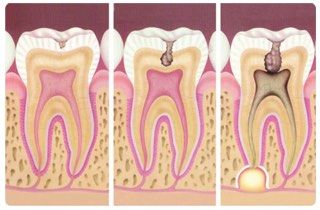 When you are not careful with dental hygiene, bacteria multiply significantly and produce more acid in your mouth; that means your teeth will wear down in specific areas more and faster.
Tooth decay gradually damages the tooth. If it is located only in the enamel, the treatment provided to your tooth is simple; but if you let too much time pass and the decay continues to advance until it overcomes the enamel, the treatment provided to your tooth is simple. enamel coating and goes further into the tooth, it will come into contact with the nerve; and of course, as you can imagine, the nerve is destroyed much faster and causes pain.
It is at this point that the tooth enters a critical phase because, if the caries is not treated in time, it will reach the pulp of the tooth and the bone and will result in a truly uncomfortable and painful infection for the patient.
How can we identify caries?
Caries can be identified because when attacking the teeth, they begin to have a different coloration, ranging from yellow and brown areas to small black spots that will grow more and more as the disease progresses.
However, when the cavities are already completely visible, we are talking about a critical state that requires urgent attention before they affect the dental pulp and a serious case of infection and pain ensues.
Treatments vary depending on the severity of the case, ranging from simple fillings, crowns, veneers, endodontics or in the worst case scenario, the loss of the tooth. But let’s analyze each of them.
What is the recommended hygiene routine to avoid dental caries?
Maintaining good oral hygiene is essential, especially after being diagnosed and treated for cavities. It is essential to closely monitor your dental health and periodically visit your dental clinic for comprehensive teeth and gum cleanings. These cleanings effectively remove plaque and bacteria, which were mentioned above. Brushing your teeth is a fundamental practice to prevent future complications and ensure the health and strength of your teeth. Remember to brush your teeth after every meal, and never forget to brush your teeth before going to bed, as this is when bacteria tend to accumulate the most.
Making appointments at your dental office at least twice a year allows your dentist to thoroughly examine your teeth and address any potential problems promptly, without further complications. By diligently following these steps, you can maintain optimal oral hygiene and promote sound dental health for years to come.
What are the symptoms of dental caries?
When we talk about the symptoms of caries, it is important to take into account its size, stage and location. In the early stages, caries may not present obvious symptoms and can only be noticed as a small black spot with the naked eye. However, as it progresses, symptoms such as sudden pain in the teeth or molars without an apparent cause or when biting may be experienced. In addition, it is common to develop tooth sensitivity to cold and sweet foods. As the decay progresses to more advanced stages, the hole will become larger and more visible, depending on its location, and may affect the nerve. In this case, the pain can be extremely intense and spontaneous, without the need for external stimuli to provoke it. It is important to note that in situations such as these, complications such as dental phlegmons may arise. Therefore, when a patient has a deep cavity that has irreversibly damaged the pulp tissue, but the tooth is still in good condition, the endodontic procedure may be required to adequately treat this condition.
Caries treatments at IMOI
Maintaining and providing for good oral health, regardless of age, is essential. Our main advice is to come and visit you in our IMOI dental clinics in Barcelona and Ibiza.
On your first visit we will perform a CT scan and a Premium Dental Study totally free of charge.
. This way you will be able to know the state of your oral health and foresee possible dental problems. In our clinics we perform any type of dental treatment with a medical team and first class facilities. Check here all the free services you will have in your first visit.
Dental fillings
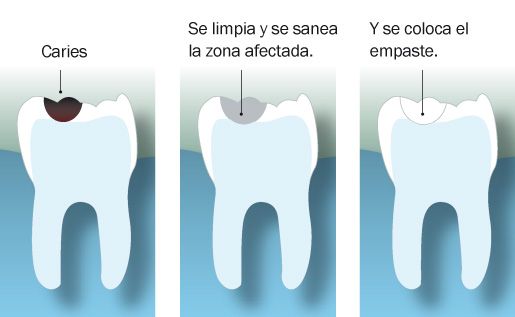
The most common and simplest treatment to combat caries is dental filling, which consists of cleaning the affected area until a cavity is formed, in order to eliminate the tissues that have been damaged by bacterial acidity. Once this process has been carried out, the cavity must be filled to return the tooth to its original shape.
For this filling there are several materials to be used, some more or less aesthetic than others:
- SILVER AMALGAM
A resource that is not esthetic, but that offers the patient advantages in its use because it is very resistant, is increasingly falling into disuse precisely because of the appearance it gives to the patient’s teeth and because of its content of heavy metals such as mercury.
- COMPOSITE
Composite is the most commonly used material for restoring decayed teeth because it is very similar in appearance to the tooth. It is the best option if you are thinking about dental esthetics
The above are the most commonly used materials, but there are other options that your IMOI Clinicas dentist will be able to offer you according to the case you present.
Crowns and/or dental veneers
When the caries have advanced much further and the filling is no longer a resource, crowns are placed, although lately there are patients who prefer the use of veneers. In both cases, a dental mold must be taken to fabricate the piece that will cover the caries file according to the patient’s needs. Learn more about dental crowns and veneers in the links above.
Endodontics
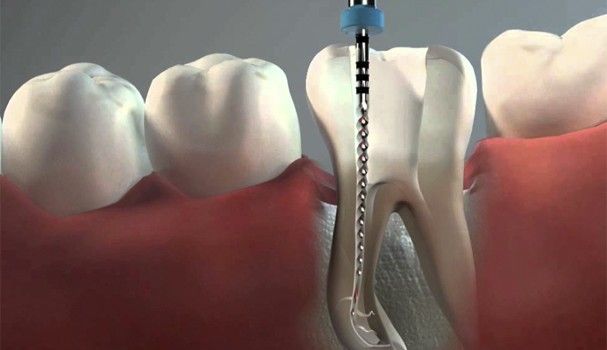
The endodontic procedure is applied when the patient already has a deep cavity that has irreparably damaged the pulp tissue but still has a tooth in good condition.
When a patient reaches the point of needing a root canal, it must be performed by a specialist in this action: a dentist specializing in endodontics, who will gradually remove the pulp of the tooth. Once this is done, the tooth must undergo special treatment to give it the strength it needs to continue to function. Regular visits to your IMOI clinic are very important to prevent these cases as much as possible.
Dental extraction
When caries has destroyed both the pulp and the tooth, and after all alternatives have been exhausted, it is likely that extraction will be necessary. A scenario that is not very favorable for the patient but that will help him to recover his quality of life.
Dental maintenance
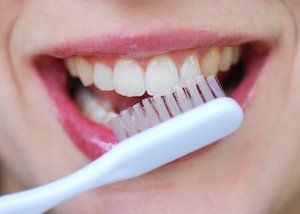 Once you have been diagnosed and treated for cavities, it is of utmost importance to keep an eye on your oral health and of course to visit your dental clinic on a regular basis for a thorough cleaning of your gums and teeth to properly remove all the decay. dental plaque or, in other words, the bacteria we talked about at the beginning.
Brushing is basic to prevent future complications and as the best method to keep your teeth healthy and strong. Remember that this should ideally be done after each meal and never forget to brush your teeth at night because it is during this period that there is a greater accumulation of bacteria.
Visiting your dentist’s office at least twice a year will allow your doctor to thoroughly check your teeth and eliminate any problems quickly, without the need for further complications.
You alone are responsible for the health of your teeth! Give them due attention!
For any questions do not hesitate to use the chat on the page, our dentists will help you.
At IMOI Barcelona and IMOI Ibiza, we follow editorial principles that guarantee the authenticity of all the information we disseminate. If you are interested in learning more about how we ensure that our content is always up-to-date and accurately supported, we invite you to review our editorial commitment.
This article has been supervised by Dr. Ferran Novell Costa and Dra. Erjona Demiraj, specialists in Dental Health and Dental Aesthetics treatments. Responsible for the treatments provided at IMOI Barcelona and IMOI Ibiza and for the supervision and/or updating of the contents of this blog entry. (7/11/2023). The recommendations described are not generic and do not replace the diagnosis and evaluation of a professional in a dental office. If you want us to clarify any aspect or you want a personalized diagnosis and advice we recommend you to come to our dental clinics.
Reproduction in whole or in part in any medium without written permission is prohibited.


